News
How NVIDIA fine-tuned Nemotron 3 for gold-level IOI and IMO 2026 results
NVIDIA details how SFT, RL and test-time loops took Nemotron 3 to gold-level IOI and IMO 2026 results, and which checkpoints and datasets are open.
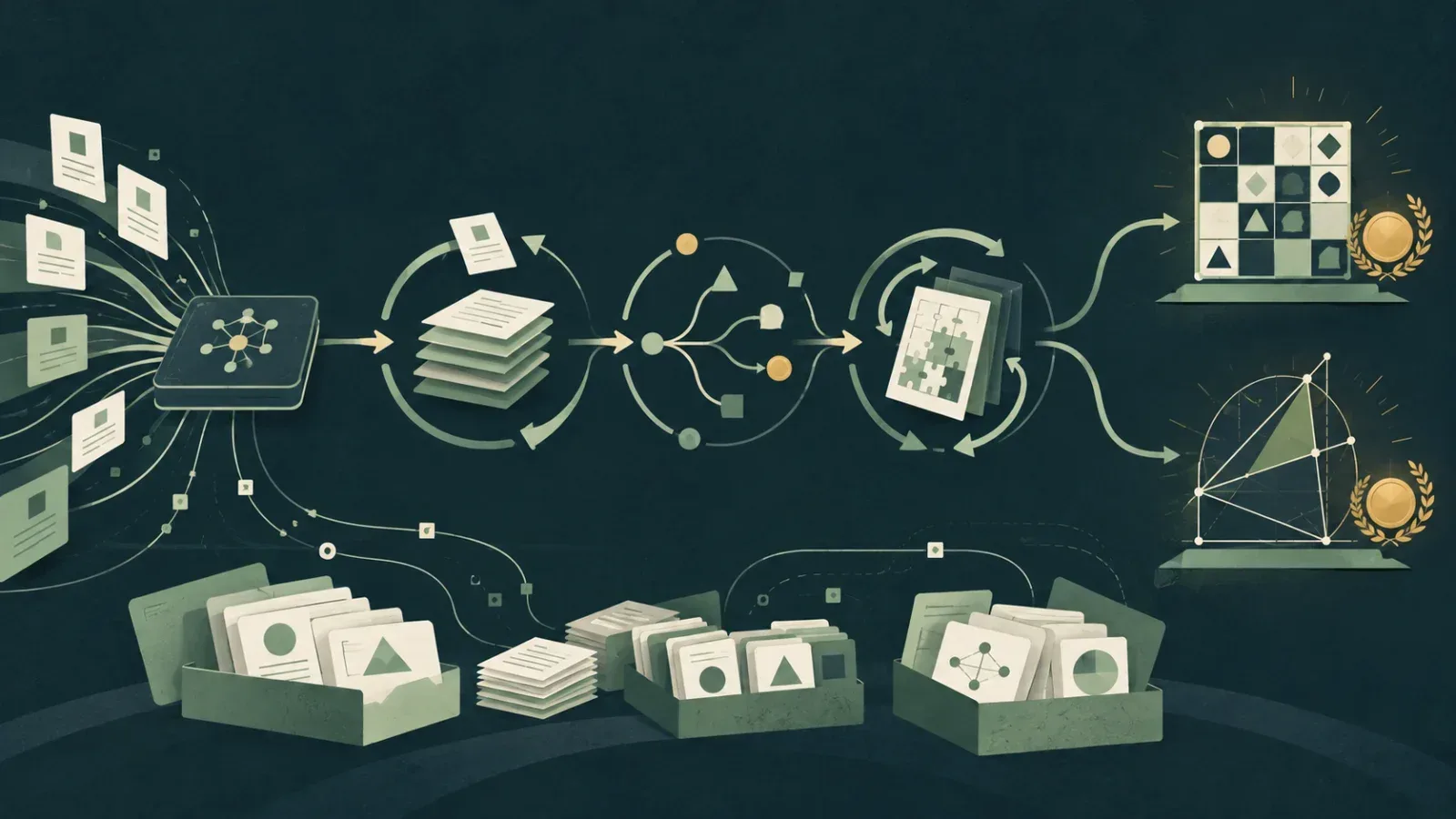
Illustration generated with ChatGPT
NVIDIA researchers published a post on the Hugging Face blog on October 7, 2026 explaining how they adapted the Nemotron 3 model family for two olympiads. A competitive coding specialist scored 535.4/600 at IOI 2026, and a math proof system scored 30/42 at IMO 2026, both above the gold thresholds. The post is a recipe write-up, and most of the checkpoints and datasets it points to were already on Hugging Face in September.
The two Nemotron results
At the International Olympiad in Informatics, Nemotron-3-Ultra-CC with SFT and GenCorrect scored 535.4/600. The gold threshold was 361.12, and the top human score was 498.27. NVIDIA ran the model live under the same time, internet-access and submission limits as human contestants. The run was an unofficial, unsupervised benchmark, and it is not part of the official IOI ranking.
At the International Mathematical Olympiad, a generate-verify-refine system combined the general Nemotron 3 Ultra model with an SFT checkpoint and an RL checkpoint. The system scored 30/42 against an official gold threshold of 29. Official IMO graders marked the submitted proofs, and the system earned full credit on four of the six problems.
The math pipeline worked entirely in natural language. According to the NVIDIA post on Hugging Face (opens in a new tab), it used no formal prover, no external tools and no internet access.
What is new in the Nemotron specialization recipe
NVIDIA's argument is that both results came from one reusable process applied to an existing base model. The steps are: start from a strong Nemotron base, curate domain problems and reasoning traces, apply standard post-training such as SFT and RL where it helps, and wrap the specialist in an inference loop that generates, checks and improves answers.
For competitive programming, the team curated 22,000 problems and generated synthetic reasoning traces. Nemotron-3-Nano-CC has 30 billion total parameters and 3 billion active parameters, and it received SFT and RL. Nemotron-3-Ultra-CC has 550 billion total parameters and 55 billion active parameters, and it received SFT only.
The IOI 2025 numbers show where each stage helped. Nano scored 130 points before post-training, 280 after SFT and 291 after RL. With GenCorrect, the team's iterative generate-evaluate-refine method, Nano reached 468 points, above the gold threshold of 438.3. Ultra-CC reached 502 points with the same method.
SFT did most of the work for Nano. For Ultra, one SFT epoch was enough to beat the fully post-trained Nano across IOI, ICPC and LiveCodeBench Pro.
The math side started from Nemotron 3 Ultra. Its SFT corpus has 414,890 quality-filtered examples across 15,818 unique proof problems. That data covers proof generation, refinement, verification and meta-verification, so the model learns to critique and repair arguments as well as write them. The RL model trained on 9,597 proof problems chosen near the model's capability frontier.
In development runs, the SFT checkpoint did best in the first search round, and the RL checkpoint had the best single-checkpoint result. NVIDIA reports that combining the two was worth more than drawing extra samples from one checkpoint.
Who the Nemotron IOI and IMO release is for
The release mainly serves researchers working on reasoning, proof verification and test-time compute. Teams that want to build a domain specialist on Nemotron get a worked example with real data sizes and stage-by-stage results.
These are data center models. The Nemotron-3-Ultra-CC model card (opens in a new tab) shows an example deployment on a single node with 4× GB300 GPUs at tensor parallel 4, and lists NVIDIA Blackwell on Linux as supported hardware. The card says the model is meant for research and benchmarking in competitive programming. It is not intended for general chat or production coding-assistant use.
How to try the Nemotron checkpoints
The competitive coding model is nvidia/NVIDIA-Nemotron-Labs-3-Competitive-Coding-550B-A55B-NVFP4, quantized to NVFP4, with context up to 262,144 tokens. Its card names vLLM as the runtime engine and recommends the vllm/vllm-openai:v0.22.0 container, with an example Docker setup for a 4× GB300 node.
The Nemotron Labs IMO 2026 collection (opens in a new tab) holds nvidia/Nemotron-3-Labs-Ultra-Math-SFT and nvidia/Nemotron-3-Labs-Ultra-Math-RL. It also has the Nemotron-Math-Proofs-v3-SFT and Nemotron-Math-Proofs-v3-RL datasets and Nemotron-IMO-Bench, which the post describes as 200 olympiad-level problems.
The Nemotron-3-Labs-Ultra-Math-RL model card (opens in a new tab) gives a single-node deployment of 8× B200 and uses the same vLLM container. Both cards carry the OpenMDW License Agreement v1.1 and state that the models are ready for commercial and non-commercial use.
NVIDIA says the IMO inference pipeline, prompts and submitted proofs are in its NeMo Skills repository on GitHub. Two arXiv papers cover the details: 2609.10712 for the IMO work and 2609.02849 for the IOI recipe and GenCorrect.
What is not known yet
- The IOI 2026 score comes from one unofficial run outside the official rankings, so it carries no official medal.
- The post calls the training and inference runs substantial. The coding model card lists 128× GB300 GPUs for training, but the post gives no compute totals or cost for the competition runs.
- The resource list in the post includes the Ultra-CC coding model but no Nemotron-3-Nano-CC checkpoint, so the 30-billion-parameter coding model's availability is unclear.
- The model cards describe specialist models. How the fine-tuned checkpoints behave on general tasks is not reported in the post.
Frequently asked questions
Can the Nemotron IOI and IMO checkpoints be used commercially?
The model cards for the coding model and the IMO RL model both use the OpenMDW License Agreement v1.1. Each card states the model is ready for commercial and non-commercial use. Read the license text on the card before deploying, since intended use is listed as research and benchmarking.
Did Nemotron win an official IOI gold medal?
No. The IOI 2026 run followed contestant time, internet-access and submission rules, but it was unofficial and unsupervised, and it does not appear in the official ranking. The IMO proofs were different: official IMO graders marked them.
What is GenCorrect?
GenCorrect is NVIDIA's test-time strategy for code. The model generates solutions, evaluates them and refines them over several rounds. The model card reports Ultra-CC results with 5 rounds of GenCorrect, and the IOI paper on arXiv (2609.02849) describes the method.
Sources
- 1.One Model Family, Two Gold-Level Results: Fine-Tuning Nemotron for IOI and IMORepositoryPrimaryhuggingface.co
- 2.huggingface.co/nvidia/NVIDIA-Nemotron-Labs-3-Competitive-Coding-550B-A55B-NVFP4RepositoryPrimary
- 3.huggingface.co/collections/nvidia/nemotron-labs-imo-2026RepositoryPrimary
- 4.huggingface.co/nvidia/Nemotron-3-Labs-Ultra-Math-RLRepositoryPrimary
Spotted an error? See our corrections policy.
Enjoyed this? Get the weekly brief.
New guides, Project & Tool of the Week and the AI developments that matter. One email, no spam.
Read next
- Weekly digest
The week on HuiaHub: sandboxed agents, RAG tooling and local models
41 new HuiaHub pages this week: sandboxing coding agents, RAG retrieval, local models on Macs and phones, Claude Haiku 5.5 and six how-to guides.
4 min read
 ExplainerAgents & automation
AI agents found in US bank accounts: what banks are blocking and why
See which banks are restricting AI agents in bank accounts, how read-only access differs from credential sharing, and which claims remain unverified.
10 min read
 GuideCoding & dev tools
PHP critical security update CVE-2026-109618: Versions and patch steps
Check the PHP critical security update CVE-2026-109618, identify affected servers, install fixed PHP versions, and apply temporary settings if needed.
12 min read