AWS lays out a seven-layer reference architecture for agents on AgentCore
AWS published a seven-layer reference architecture and sample repo for multi-agent apps on Bedrock AgentCore. What each layer does and how to try it.
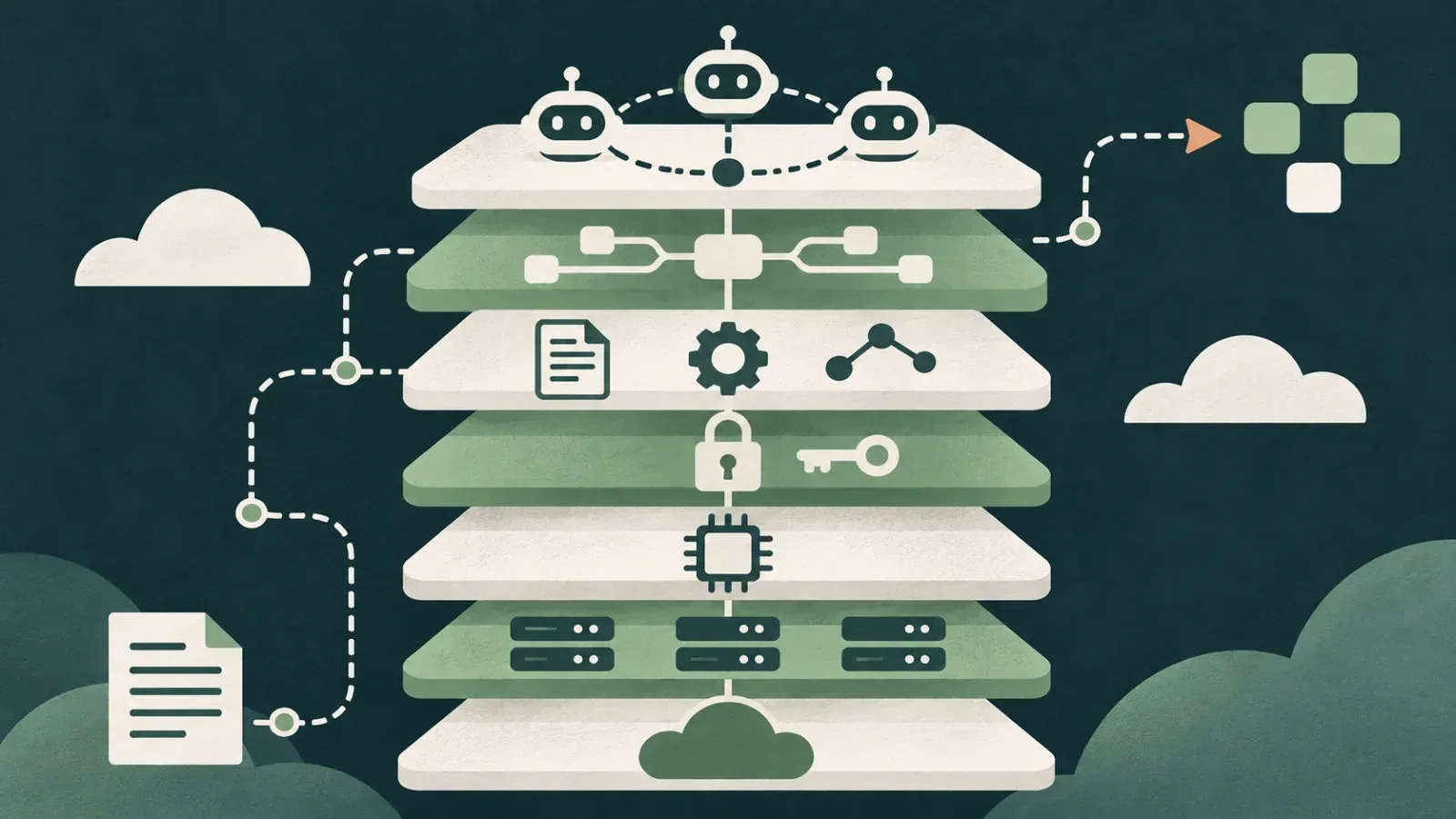
Illustration generated with ChatGPT
On 9 November 2026, four AWS solutions architects published the Pluggable Agentic AI Framework on the AWS Machine Learning Blog. The framework is a reference architecture for moving multi-agent applications from prototype to production on Amazon Bedrock AgentCore. It comes with a sample repository and a workshop built around a retail customer support scenario.
What the Pluggable Agentic AI Framework contains
The AWS post (opens in a new tab) splits an agent system into seven layers. Each one has its own responsibility and a stable contract with its neighbors. AWS says the services named in each layer belong to the reference implementation and are not mandatory, so a team can substitute tools it already runs.
The seven layers and the example services the post names:
- Data and Knowledge: retrieval, embeddings and access to structured and unstructured data. Examples are Amazon Bedrock Knowledge Bases, the vector engine for OpenSearch Serverless, Amazon S3 Vectors and DynamoDB.
- Model and Inference: model choice driven by configuration, with a routing proxy such as LiteLLM in front of providers.
- Orchestration: a single agent for simple tasks, or a supervisor that delegates to scoped specialist agents, found through a central registry and called over MCP or A2A.
- Security and Guardrails: authentication on every request, a permission check on each tool call before it runs, short-lived scoped credentials, and masking of PII and PHI.
- Application: a thin chat, API or widget layer that passes requests down to orchestration.
- Observability: traces, cost and token usage per request, and time to first token, using CloudWatch with OpenTelemetry.
- Agentic Operations: scoring production sessions for groundedness, accuracy and safety, with a regression gate before releases.
For orchestration the post suggests Strands Agents for specialists and the AgentCore harness as the orchestrator. AWS Agent Registry and AgentCore Gateway handle discovery and routing.
What is new and what already existed
The post does not announce a new AWS service. Its parts (harness, Gateway, Identity, Policy, Evaluations, Agent Registry) each have their own page in the AgentCore developer guide. What the post adds is an opinionated layout of those parts, plus advice such as keeping business logic out of the application layer and avoiding a single agent that does everything. AWS argues that as tools and context pile up in one agent, latency rises and accuracy can drop.
The post also describes a decision model at the application boundary. A single call scores whether a request is in scope, needs a human or is urgent, and returns probabilities rather than free text. Code then applies thresholds, so the full agent loop runs only when needed.
Who the reference architecture is for
The material targets teams building supervisor-and-specialist agent systems on AWS. AWS tags the post Expert (400). Teams that already run their own observability, security or inference tools are the stated audience for the pluggable design: AWS says they can keep those tools and adopt the rest one layer at a time.
In the retail example, a supervisor agent receives a refund request and hands work to an Order agent and a Refund agent. The Order agent reads delivery and purchase details from DynamoDB. The Refund agent pulls tier-based policy rules from a knowledge base and computes eligibility from the delivery date, the current date and the customer's loyalty tier.
Every tool call passes through AgentCore Gateway, where Policy in AgentCore checks access before the tool executes, and each call is traced end to end. Readers new to tool servers can see the MCP side in how to build an MCP server in Python.
How to try the sample
AWS points readers to a Workshop Studio session (linked from the post) and the public sample-pluggable-agentic-ai-framework repository (opens in a new tab), licensed MIT-0. The repository is a set of Jupyter notebooks run in a fixed order. Each layer writes resource IDs to SSM Parameter Store for the next layer to read.
Prerequisites listed in the README:
- An AWS account with Bedrock model access enabled for Claude Sonnet and Titan Embeddings V2.
- Python 3.9 or later with
boto3configured. - Optionally, a Fireworks AI API key for non-Bedrock inference.
The README estimates a single workshop run costs under $5, and each notebook has a cleanup cell that deletes the resources it created. The data layer loads a CustomerOrders DynamoDB table with 25 sample orders.
Limits and open questions
The repository and the post do not match on structure. The blog describes seven layers, while the README organizes the workshop into five labs: data and knowledge, inference, orchestration, security, and observability. Application and Agentic Operations have no lab of their own in the README, though the orchestration lab includes a Streamlit chatbot notebook.
Third-party support is also thinner in the code than in the post. The blog says the framework shows integrations with third-party providers across the layers. The README's integration table lists "Upcoming" for four of the five layers and says partner integration content will be published soon, with work in progress for NVIDIA, Datadog and Dynatrace. Fireworks AI is the one non-AWS model provider the README names, and the table says its notebooks will be available soon.
AWS and the README both say the sample is not ready for production without further security hardening, testing and review. Neither source gives AgentCore pricing or a list of supported Regions.
Sources
- 1.Pluggable Agentic AI Framework: A seven-layer composable enterprise agentic AI reference architecture on Amazon Bedrock AgentCore | Artificial IntelligenceOfficial docsPrimaryaws.amazon.com
- 2.docs.aws.amazon.com/bedrock-agentcore/latest/devguide/policy.htmlOfficial docsPrimary
- 3.github.com/aws-samples/sample-pluggable-agentic-ai-frameworkRepositoryPrimary
Spotted an error? See our corrections policy.
Enjoyed this? Get the weekly brief.
New guides, Project & Tool of the Week and the AI developments that matter. One email, no spam.
Read next
- ComparisonAgents & automation
Hermes Agent vs OpenClaw: which self-hosted AI agent fits you
Compare Hermes Agent vs OpenClaw on license, install, models, chat channels, memory and security defaults, then pick the self-hosted agent that fits.
7 min read
- ExplainerAgents & automation
Is OpenClaw safe to run? What the documented incidents and its own security docs say
Check the dated OpenClaw incidents and advisories, see what its security docs recommend, and harden your own install with a checklist from those docs.
7 min read
 NewsAgents & automation
GitHub Agentic Workflows goes GA with new runner and model options
GitHub Agentic Workflows is now generally available for developers, with new runner options, model routing, spending forecasts, and isolation controls.
4 min read
More on these topics
Related agent skills
BioMCP biomedical research
genomoncology/biomcp
Guides agents to search biomedical data on genes, variants, trials, diagnostics, drugs, diseases, pathways, proteins, drug safety, and research papers.
No scriptsNetwork accessNo hooksNo secretsClaude Code, Codex, Claude Desktop★ 668checked
Related videos
 13:27intermediate
Your Financial Agent Needs to Show Its Work - Anirudh Veeraragavan, Fieldguide
A 13-minute talk on four safeguards that make a financial audit agent's decisions traceable, for engineers building agents for finance and audit work.
AI Engineer · 160 views ·
 2:10:16beginner
MCP Security Fundamentals Course
A security course for developers working with MCP and AI agents, covering protocol basics, the OWASP MCP Top 10, real-world incidents, and defensive measures.
freeCodeCamp.org · 89K views ·
 14:38intermediate
Stop Giving Your Agent Tools. Give It a Sandbox - Mikyo King, Arize AI
For developers building AI agents, Mikyo King explains code mode, how Phoenix uses sandboxes, the problems it introduces, and measured token and cost savings.
AI Engineer · 30K views ·
 14:07intermediate
Three Questions Every Agent Engineer Should Be Able To Answer
A 14-minute LangChain talk on finding, reproducing and fixing agent failures using production traces, for engineers who run agents in production.
LangChain · 8.1K views ·